

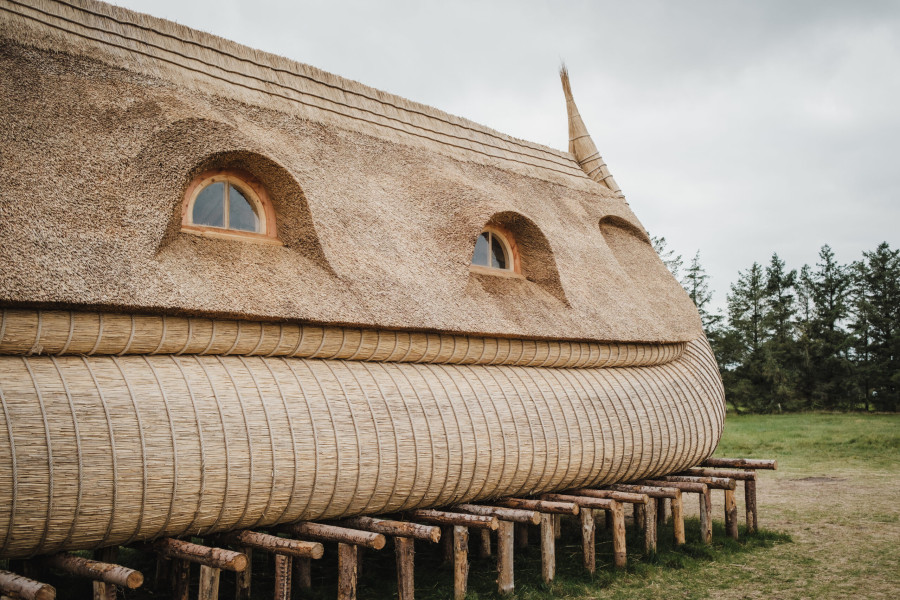
Houseboat for Ho (Husbåd til Ho) is both a locally inspired land‑based dwelling and an exotic vessel, constructed using two related yet geographically distant techniques: reed‑boat building and thatching. The ark‑like hybrid structure is thus split between land and sea and is the result of a cross‑cultural collaboration—an exchange of ancient techniques and stories between Danish thatchers and Bolivian reed‑boat builders.
Although individual stalks of straw are fragile on their own, certain grasses—especially reeds—can be used in bundles for building structures when other materials are not available. Such bundles of reeds are the primary building elements of both the reed boat and the thatched roof.
The earliest thatched houses were built in what was known as the “Germanic settlement area,” which during the Late Neolithic period covered what we today know as Schleswig‑Holstein and southern Denmark. During this time, a shift took place from nomadic hunter‑gatherer cultures, which favored light and mobile dwellings, to settled communities of farmers and fishers who required durable and resilient homes. Animal skins, leaves, and branches were replaced by more robust materials, including reeds for roofing. Settlements became villages, and villages became towns, and over time thatched roofs were phased out in urban contexts to reduce the risk of fire. In rural settings, however, thatching has remained a popular building technique and is increasingly regarded as a sustainable and energy‑efficient solution. Many beautiful examples of traditional thatching can be found in the area around Ho, alongside innovative uses in contemporary architecture, such as Dorte Mandrup’s award‑winning Wadden Sea Centre in Ribe.
Reed‑boat building is a craft with a long tradition, and the oldest known remains of reed boats can be dated back 7,000 years. The tradition is kept alive by Aymara and Uru boat builders in the region around Lake Titicaca in the Andes, as well as by fishing communities along Peru’s Pacific coast. Reed boats can still be found on Lake Chad in Africa and in Mesopotamia (present‑day southern Iraq), where the Tigris and Euphrates rivers meet, and where the Marsh Arabs continue to build boats, buildings (mudhif), and floating islands from reeds.
A Cross‑Cultural Partnership
Reed‑boat building and thatching use the same raw material: bundles of reeds. In the hybrid structure Houseboat for Ho, where a house becomes a boat and a boat becomes a house, there is a seamless transition from vessel to roof. The orientation of the reeds shifts according to their position within the structure: from the buoyant horizontal bundles at the base of the boat, which rise into the curved bow and stern, to the weather‑resistant, vertical bundles of the thatched roof. This shift from horizontal to vertical and back again is likewise emblematic of the cross‑cultural collaboration—a combination of two ancient building techniques from otherwise separate cultures in the Northern and Southern Hemispheres, brought together in a single, composite structure.
The project is supported by the Danish Arts Foundation and the Art Committee of Varde Municipality.
INFO
Title: Houseboat for Ho, 2023 (Husbåd til Ho)
Artist: Simon Starling (b. 1967)
Material: Reeds
Location: Hovej / Juulsvej, Ho, 6857 Grønbjerg
Year installed: 2023
Donated by: The Danish Arts Foundation and Varde Municipality
BIO
Simon Starling (b. 1967) is a British artist based in Copenhagen. Since the mid‑1990s, he has created numerous works involving different types of boats. In 1997, he built a small fishing boat from a museum display case from the National Museum of Scotland in Edinburgh, which he subsequently burned to charcoal to be used for cooking the boat’s catch (Blue Boat Black).
In 2006, he fed a wooden steamship into its own boiler (Autoxylopyrocycloboros), and in 2015 he built a canoe from magnesium extracted from the Dead Sea to sail from Israel to Jordan (Project for a Rift Valley Crossing). Houseboat to Ho continues his long‑standing interest in the ancient relationship between architecture and boat building.