
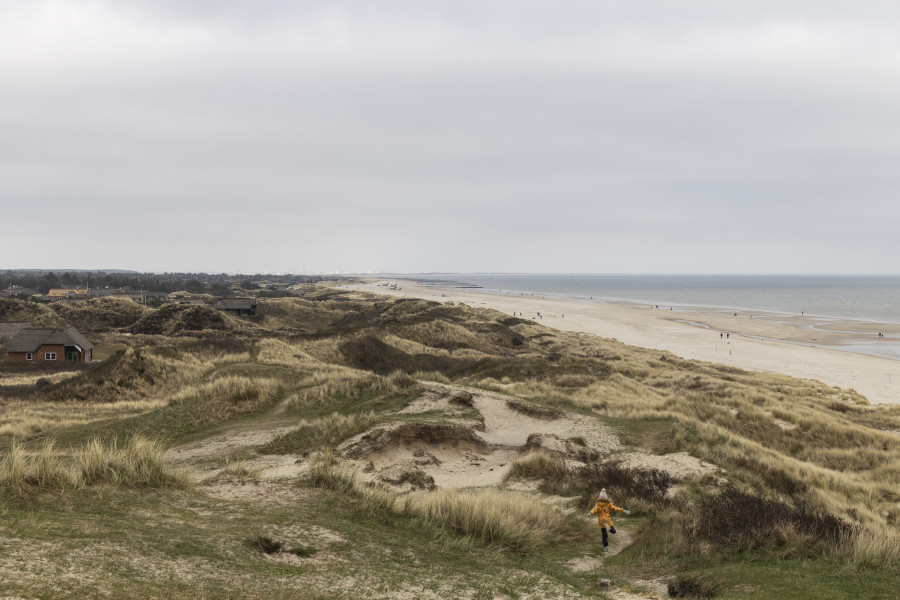
Twice a day, the tides move in over the land and retreat again in a recurring, cyclical motion. At times, the water reaches all the way up to the dunes, pushes into the bay, flows up the river, and spreads across the meadows before returning to its “normal” level. In the Wadden Sea region, people live with the water as both a life‑giving and potentially dangerous force.
Can modern humans, here in this very place, rediscover—and reimagine—the insight needed to understand the ecological systems we are part of, and prepare ourselves for a future shaped by a changing climate? Can we gain new understandings of our relationship with nature through sensory experiences and artistic encounters? These questions form the starting point of the exhibition Bringing In The Tide, Wadden Tide 2026, which takes place in the northern Wadden Sea.

For Bringing In The Tide, artists from Denmark, the Nordic region, and the North Atlantic have been invited to develop works that bring different perceptions of nature into play and inspire us in the transition toward a new era.
Writers, visual artists, dancers, architects, and landscape architects create works rooted in the dynamic ecosystem of the Wadden Sea, developing performances, narratives, sculptures, and installations that engage directly with a landscape shaped by tides, wind, and human stewardship.
The artistic contributions open up new understandings of the natural foundations we depend on and offer experiences of a dynamic landscape that is both shaped by and beyond human control. At the same time, artists from other Nordic and North Atlantic cultures bring alternative perspectives, shaped by living in regions where the forces of nature still hold sway.
Art can bring audiences closer to the rhythms and interconnections of nature, within a landscape that is already mapped, regulated, and protected. Here, art can offer another form of knowledge—experiential, embodied, and relational—and contribute to a more nuanced understanding of how we live with and within a landscape in transformation and an unpredictable climate. The intention of the exhibition, then, is not to illustrate nature, but to create new relationships with it.
Bringing In The Tide offers insight into alternative understandings of nature and forms of experience that cannot be measured or mapped alone, but must be felt, lived, and negotiated. The works open up new relationships to the ecosystem of the Wadden Sea—its sand, sea, tides, marshlands, and birdlife—and invite a more embodied and situated understanding of how we perceive, experience, and live with a fragile and regulated ecosystem. The works engage with time, materials, scale, and movement, offering sensory encounters with the ecosystem and suggesting new ways of being in—and with—the landscape.
The works in the exhibition are inspired and informed by the geography, ecology, and the landscapes—both natural and human‑made—of the Wadden Sea region, as well as by the understanding of nature that shapes how Denmark today manages the natural heritage designated by UNESCO as irreplaceable.
Several of the exhibition’s works are deeply rooted in the site while at the same time reaching far across time and place, while others vibrate in encounters between different species, bodies, and senses. Some of the works point to political questions about how we manage our landscapes and habitats—not only on a conceptual level, but also in practical terms, as responses to the paradoxes the artists have encountered in engaging with the site, and to the different understandings of nature that shape contemporary governance, raising questions such as:
How can we act and operate within a dynamic landscape?
Do we have the cultural understanding and tools to manage an ecosystem in motion?
And in what situations is human activity in nature considered legitimate?
An Expanded Format
Bringing In The Tide follows on from First There Is A Mountain, Wadden Tide 2023, which addressed sand as history, resource, and material, inspired by how Blåvandshuk was formed through the erosion of sand from the Wadden Sea islands of Langli, Fanø, and Rømø. First There Is A Mountain, which took place at Blåvand Beach, was flooded during a storm surge that destroyed most of the artworks.
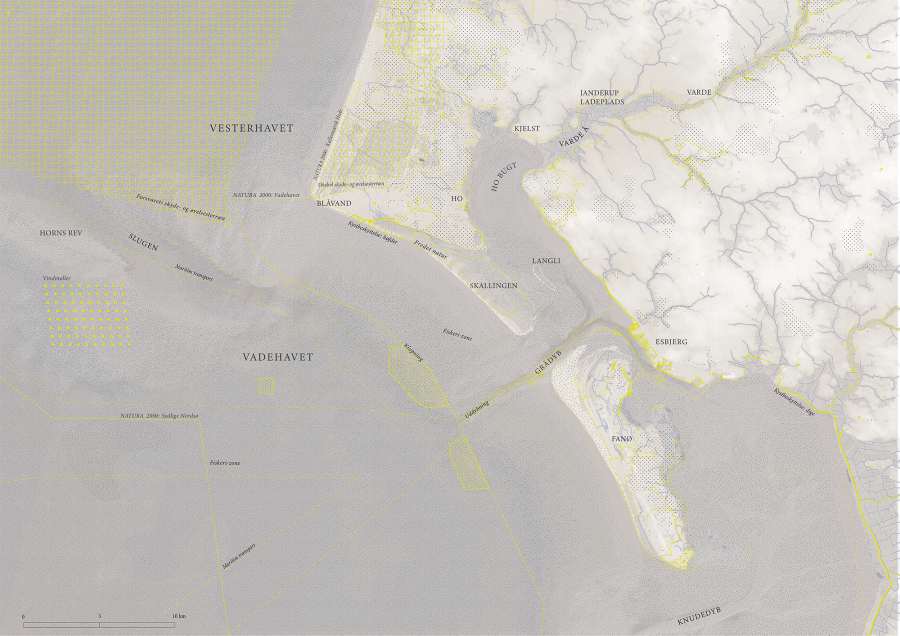
The exhibition title Bringing In The Tide is inspired by the Wadden Sea tradition Vi Henter Tidevandet Ind (“We Bring In the Tide”), which takes place annually in Ballum and celebrates the marshland and the tides. In 2026, the exhibition returns in an expanded format, unfolding throughout the season, in multiple phases, with interventions at Blåvand Beach (Blåvand Strand), on the Skallingen, at Ho Bay (Ho Bugt), and along the Varde River (Varde Å).
From May 4, the public can experience performances and take part in walks and workshops. On August 22, the exhibition culminates in installations, sculptures, and performances at Blåvand Beach, along with two works situated in the tidal landscape.
With a total of six out of twelve works, performative practices play a more prominent role in the programme, reflecting an ambition to engage directly with the changing landscape, the cycles of nature, and time. There is also an ambition for more works to be permanent, contributing to strengthening Blåvand and its surroundings as a cultural destination for high‑quality, site‑specific art.
Contributions by Researchers and Local Communities
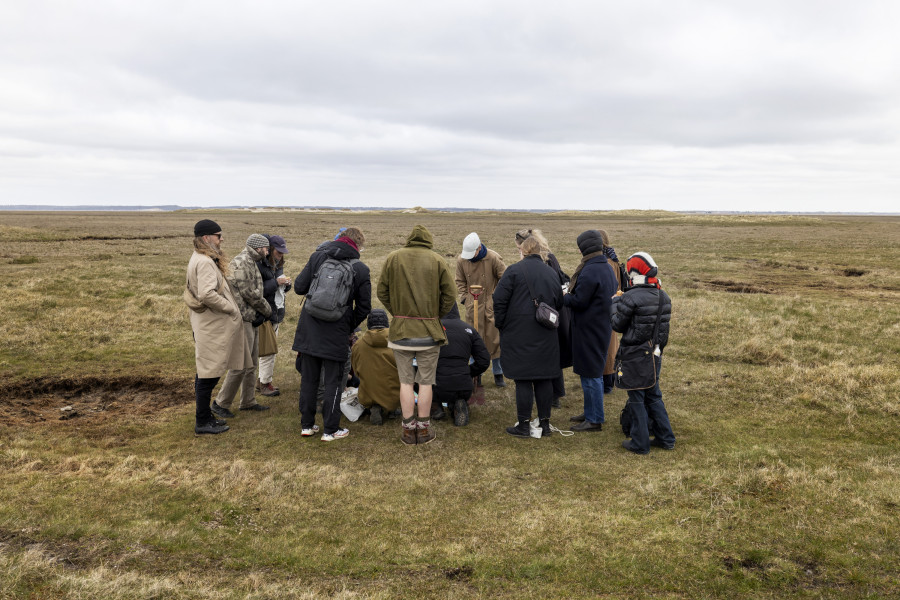
Over the course of a year and a half, Bringing In The Tide has taken shape through an interdisciplinary and dialogic process, marked by cross‑pollination of experiences, knowledge, and ideas, and an ongoing exchange between local communities, researchers, and artists. The initial starting point was a two‑day site visit in Blåvand, Skallingen, and Ho, featuring walks and research presentations on topics including marshland geology, coastal geography, regenerative tourism, and the role of the sea in literary history.
Bringing In The Tide has been developed with input from researchers and local stakeholders, who have inspired the artists and informed the artworks, including:
Carlo Sass Sørensen, coastal engineer and Head of Climate Adaptation, Danish Coastal Authority
Mikkel Fruergaard, coastal geographer and Head of the Skallingen Laboratory, University of Copenhagen
Janne Liburd, Distinguished Professor in Tourism, Serra Húnter Programme, University of Girona
Søren Frank, Professor of Nordic Literature, University of Copenhagen
Katrina Wiberg, landscape architect and Head of the Centre for Future Landscapes
Anne Husum Marboe, development consultant, Wadden Sea National Park
Josephine Nielsen Bergqvist, curator, Vardemuseerne
Mariane Nygaard Holm, Chair, Blåvand‑Ho Residents’ Association
Karin Elsbudóttir, Director, The North Atlantic House
Trine Just Hansen, art and cultural mediator, NaturKulturVarde, Vardemuseerne
Gitte Søndergaard, former development consultant, DGI Sydvest
Janne Clausen Hansen, library development specialist, Varde Library
Empathic Environments
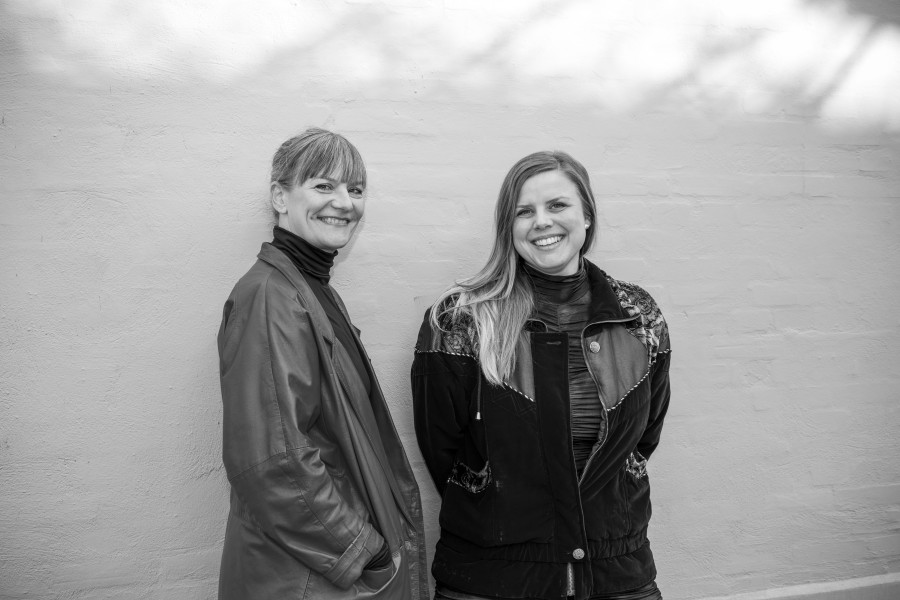
Empathic Environments curates, produces, and communicates art and cultural programmes in public spaces. Through interdisciplinary exchange, collaborative practices, and close dialogue with local communities, the curatorial duo generates new ideas and understandings of places and the issues connected to them. Empathic Environments consists of Stenka Hellfach and Tyra Dokkedahl.
Stenka Hellfach is an art historian working at the intersection of philosophy, the natural sciences, and history, with a focus on humanity’s relationship to time, nature, and the future. She curates forward‑thinking and relevant art projects and mediation initiatives that contribute to the ongoing discussion of what public art can be today.
Tyra Dokkedahl er arkitekt MAA og journalist og især optaget af menneskers forhold til steder, steders særegne kulturer og bæredygtig udvikling. Hun udvikler originale strategier og koncepter, faciliterer tværfaglige samarbejder og bidrager til praksis gennem metodeudvikling, formidling og videnproduktion.
INFO
The art exhibition Bringing In The Tide, Wadden Tide 2026 takes place in the northern Wadden Sea, a UNESCO World Heritage Site. Bringing In The Tide presents twelve site‑specific works by Nordic and North Atlantic artists working across literature, visual arts, dance, architecture, and landscape architecture. Participating artists include Andri Snær Magnason; Amitai Romm and Djernes & Bell; Ava Samii; AVPD; David Garcia; Faun Vium & Therese Bülow; Jessie Kleemann; Juha Pekka Matias Laakkonen; Nana‑Francisca Schottländer; New Mineral Collective; Rammatik; and Sophie Sahlqvist.
In 2026, the exhibition unfolds in multiple phases, with events taking place at Blåvand Beach, on the Skallingen peninsula, at Ho Bay, and along the Varde River. From May 4, the public can experience performances and participate in walks and workshops. On August 22, the exhibition culminates in installations, sculptures, and performances at Blåvand Beach, as well as two works situated within the tidal landscape.