
Every day until September 20, visual artist Juha Pekka Matias Laakkonen will be working at various locations between Blåvand Beach, Grønningen, and Skallingen. He will anchor himself to the landscape with a 5-meter-long rope and work with the physical site within reach to create circular spaces for contemplation.
He completes one task per day, and the schedule depends on the day’s conditions. Laakkonen’s starting point is Blåvand Beach, where he will construct a kite. Just as Laakkonen is anchored to the ground, the kite must also remain in contact with the ground in order to fly. As soon as the kite is in the air, he moves on to the next location.
Blackbirding refers, in part, to the blackbird, a terrestrial and seemingly hidden driving force in our surroundings. From a darker perspective, the title refers to the British Empire’s abduction of people from the Pacific Islands for forced labor, derogatorily referred to as blackbirds. The Pacific Islands have a long tradition of flying kites and, like the Wadden Sea, are vulnerable to rising sea levels.
The work is a poetic, humorous, and critical commentary on labor, nature, history, and modernity.
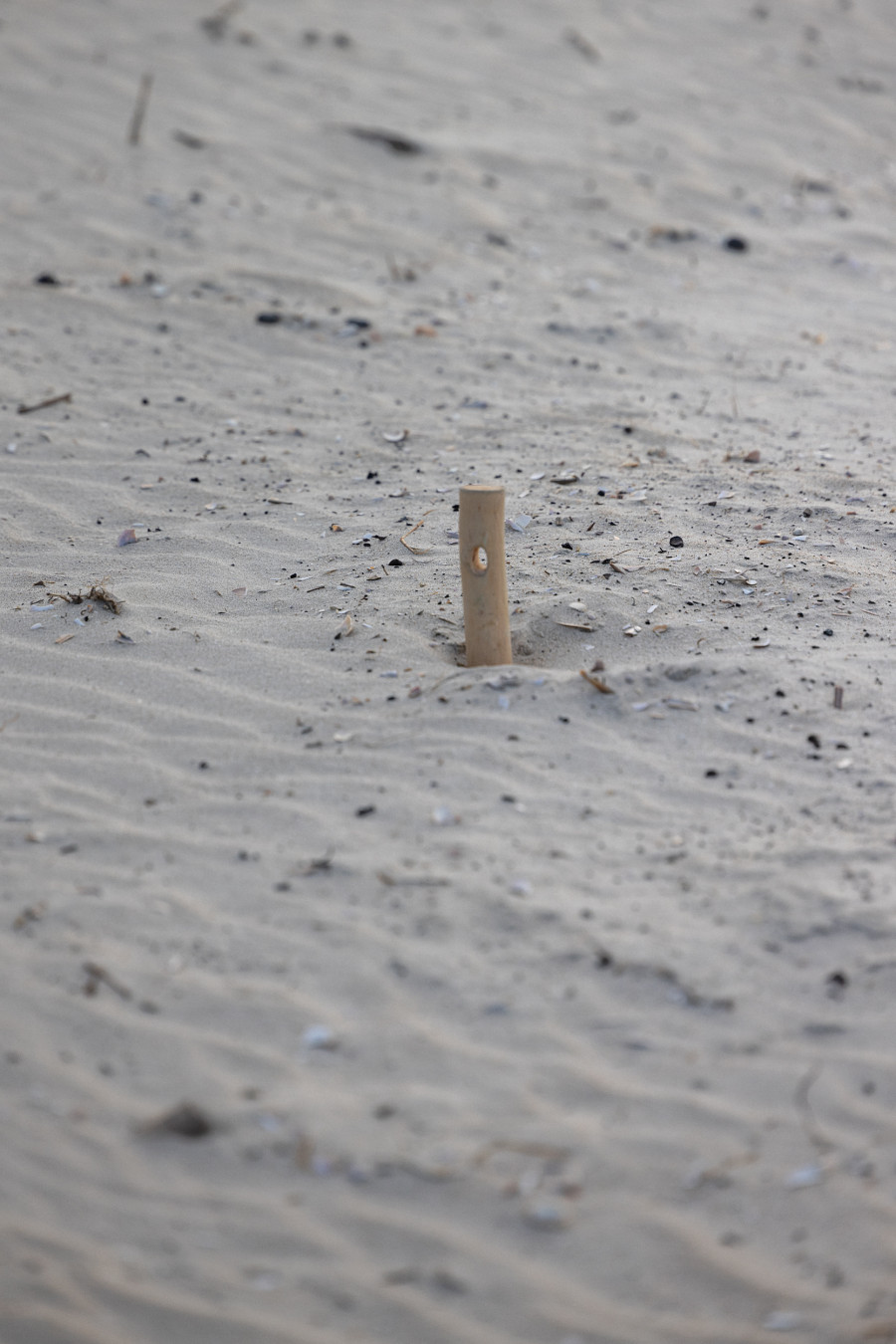

Juha Pekka Matias Laakkonen is known for his uncompromising investigations of the relationship between humans and nature. While his works may at first resemble studies of nature, they in fact challenge the boundaries of the natural and the extent of human intervention within it. With an often ironic tone, he points to the human urge to preserve the existing state of things—an impulse that, from a broader perspective, can appear both self‑important, paradoxical, and ultimately futile.
BIO
Juha Pekka Matias Laakkonen (b. 1982, Helsinki) is a Finnish visual artist educated at Nordiska Konstskolan in Kokkola, Finland, and at Malmö Art Academy in Sweden. Laakkonen is represented by Corvi‑Mora Gallery in London.
He has exhibited nationally and internationally in both solo and group exhibitions, including the solo exhibition Buoyancy (2022) at Gasworks in London, which included a performance unfolding throughout the entire exhibition period, and Argonaut (2023) at Corvi‑Mora. In 2024, he participated in the group exhibition After the Sun at Kunsthal Gammel Strand in Copenhagen, presented in close collaboration with the Buffalo AKG Art Museum in the United States, where the exhibition had been shown earlier that year.