
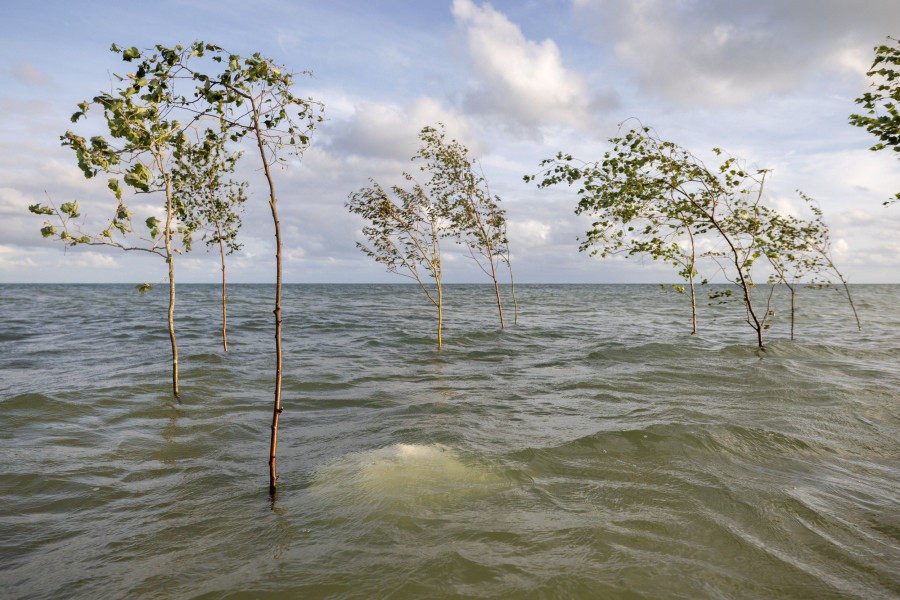
Landscape architect Sophie Sahlqvist's The Drowned Garden is about creating a greater sense of connection between us humans and the ever-changing tidal landscape of the mudflats. The work explores the values, lives, and landscapes we stand to lose, and how they can adapt in the face of future changes.
The work draws on a local tradition from Mandø, where young trees are used to find one's way across the open tidal landscape when the water recedes. The cyclical nature of the Wadden Sea - with its tides, the moon's orbit, wind, and weather - is part of the experience and reflects the landscape's own movement and transformation.
Inside the artwork is a cast of a horse's head, taken from one of the two horses of Selene, the goddess of the moon. The cast serves as a hidden historical element in the artwork, linking myths, the moon, and tidal culture. Echoing
J.C. Ballard's novel The Drowned World (1962), which foreshadows current planetary changes, the garden also evokes contemporary sea-level rise.

Sophie Sahlqvist works at the intersection of structured and open artistic forms. She explores the poetics of place and the human capacity to experience the world through the senses. Her projects take shape as future landscapes and new forms of nature, created through hybrid combinations of materials and processes, and form spaces for community, negotiation, and interaction.
Her projects are rooted in specific sites, drawing on the natural conditions of the landscape, temporal dimensions, climate, and historical traces. Through site‑specific experiences and narratives, she seeks to create a sense of connection with the environments we inhabit and draw from. These narratives address what we stand to lose, but also how life and physical surroundings can transform and adapt.
BIO
Sophie Sahlqvist (b. 1973, Sweden) is a practising landscape architect working within landscape art. She has realised a number of interdisciplinary art and architecture projects in Denmark, Sweden, and Norway, including Indsande in collaboration with artist Astrid Myntekær, and Hybrid Mutations, 111 White Plateaus, among others, in collaboration with artist Ann Lislegaard.
She is currently working on the realisation of Holmsland Hotspot, a large‑scale landscape sculpture in collaboration with artist Mette Winckelmann and Martin Winther, supported by the New Carlsberg Foundation and Realdania, as well as a landscape installation for Munkeruphus. Sahlqvist lives and works in Copenhagen and, alongside her practice, teaches at the Royal Danish Academy.