
Performance artist Jessie Kleemann’s performance draws on the Greenlandic legend of “the flying kayak” and reflects the living conditions of the Greenlandic people and their relationship to nature, the spiritual, and the supernatural. Spirit of the Flying Kayak expands the view of nature from the local to the global by placing the landscape of the Wadden Sea in dialogue with the Greenlandic view of nature.
Here, a different and more spiritual relationship between humans and the outside world is at play, where nature is more than an ecosystem or a resource to be exploited, but a living, animate space with which humans form a relationship. Kleemann’s performance draws on legend and myth as a form of knowledge and highlights that stories, spirituality, and cultural and bodily experiences are also ways of recognizing and understanding nature.
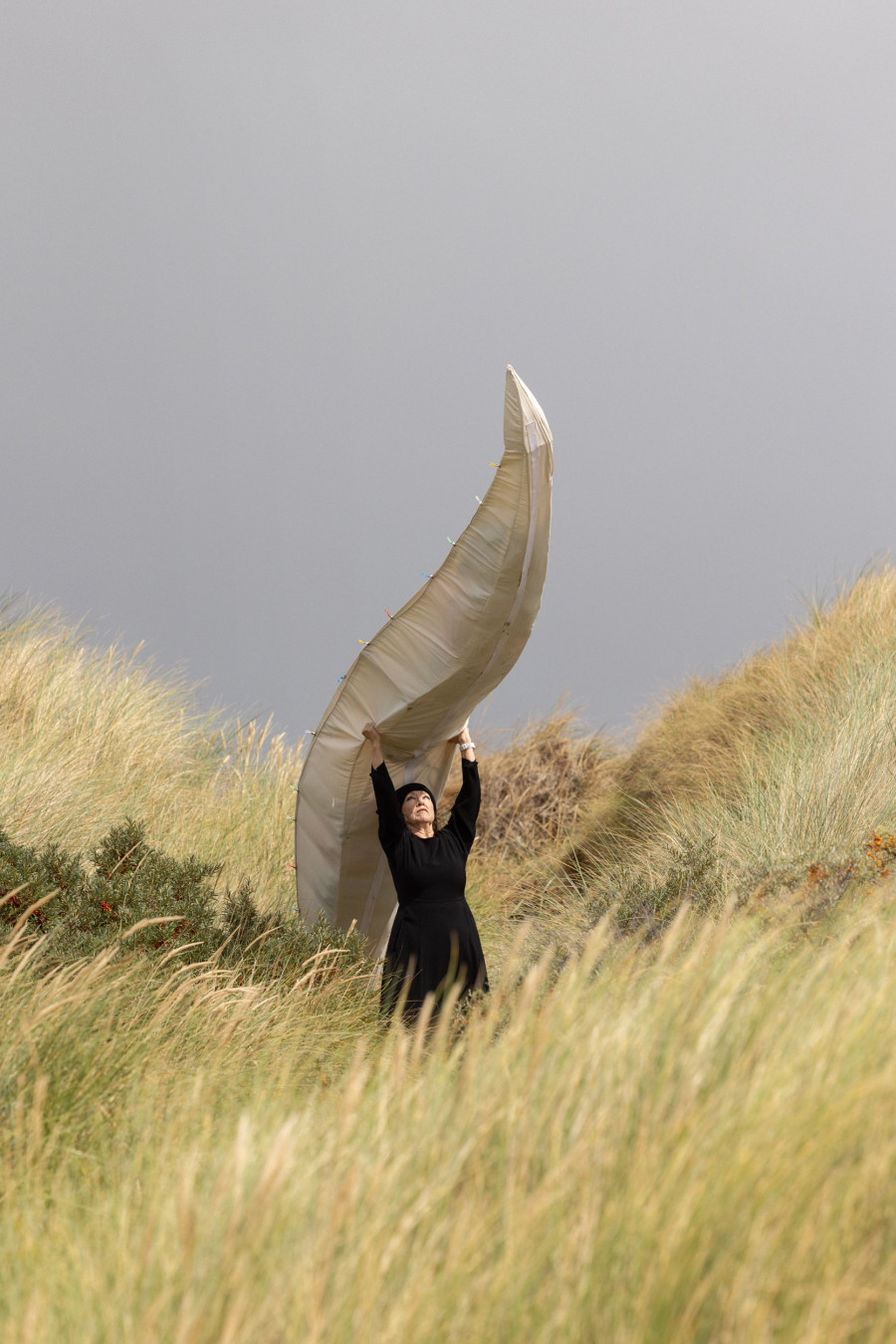

A central theme in Jessie Kleemann’s artistic practice is global climate change, which manifests with striking clarity in the Arctic and in Greenland (Kalaallit Nunaat). Arctic pain forms a recurring undertone in her work, and she often uses her own body as a tool to awaken our memory of and connection to the landscape, to myth, to the future, and to Greenland—thereby opening a bodily language that we can sense and reflect upon.
BIO
Jessie Kleemann (b. 1959, Greenland) is a Greenlandic performance artist, painter, installation artist, and poet. She trained as an actor at Tuukkaq Theatre in Denmark and as a visual artist at the Graphic Workshop in Nuuk. Her practice includes video works, sculptures, installations, and live performances. From 1984 to 1991, she was director of the Art School in Nuuk. Her most recent book, Arkhticós Dolorôs (2021), was nominated for the Nordic Council Literature Prize in 2022 as well as the Danish Poetry Prize. In 2023, she presented two major exhibitions: Time Runs Runs Time at the National Gallery of Denmark (SMK) and Lá: Læ: Likkja.Magna at Rønnebæksholm Art Hall.