
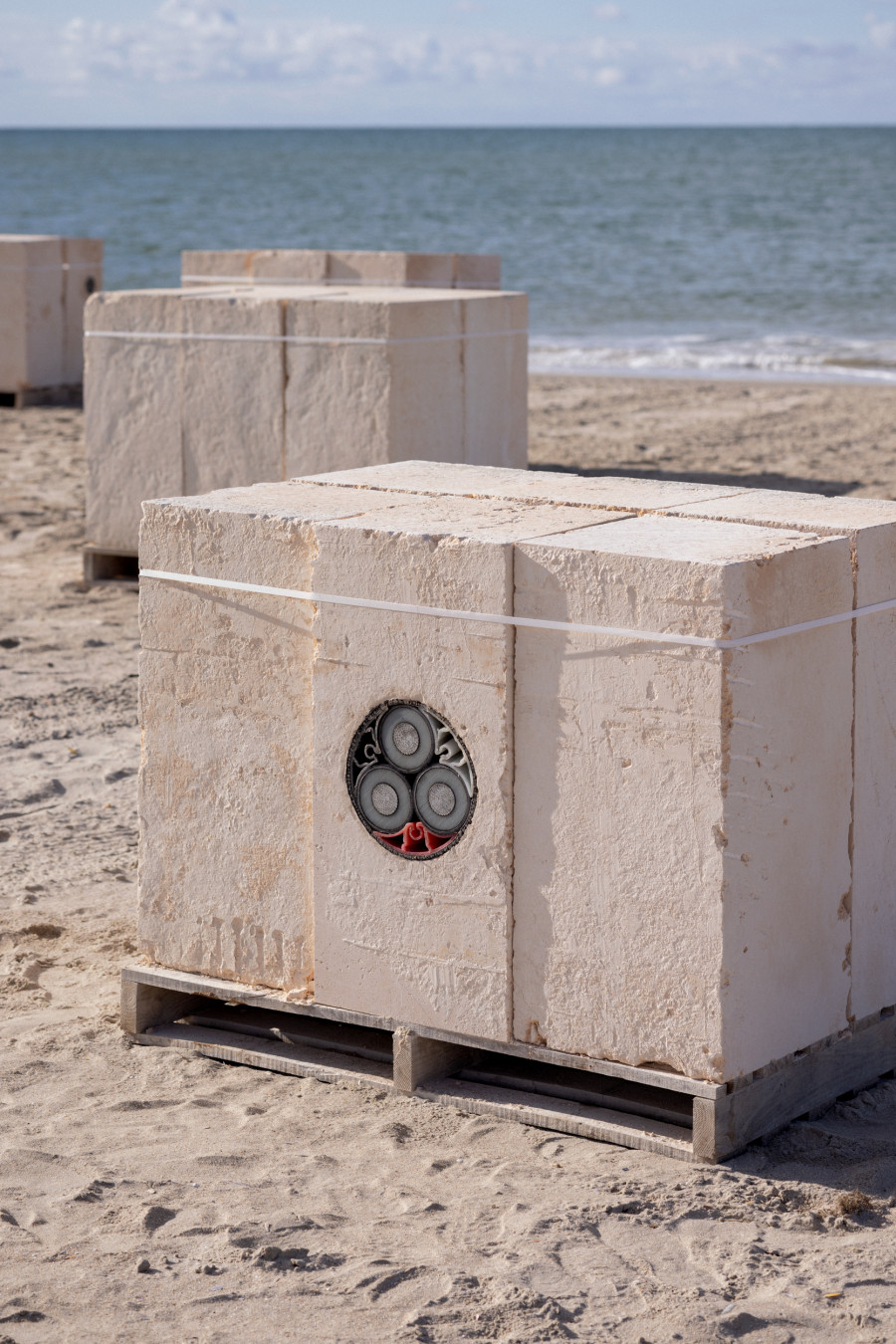
Scattered along the beach are blocks of marés stone on pallets, quarried in Mallorca and shipped to Blåvand. Like the beach itself, they consist of sand, but in a fossilized form, compressed over millions of years. The artist and architect have embedded in the stones debris from the infrastructure currently operating along the west coast, including sand replenishment projects, such as pipe sections, flanges, and discarded submarine cables.
Along the west coast, both fixed coastal protection and sand nourishment are used to protect the coast from erosion. Fixed coastal protection, combined with rising sea levels, can limit the coast’s natural ability to move inland and create coastal squeeze. Sand nourishment adds sediment to counteract erosion and preserve the coast’s natural habitats, thereby helping to counteract coastal squeeze.
The work depicts sand nourishment as a geological process and illustrates how future coastal protection measures will be deposited in the Earth’s strata.
Thanks to: Rohde Nielsen, JD-Contractor
Support: Danish Arts Foundation and the Knud Højgaard Foundation

BIO
Amitai Romm (b. 1985, Jerusalem) is a visual artist based in Copenhagen. His sculptural practice explores how environments and artefacts are intertwined with larger systems. Through installations, standalone works, and collaborative projects, he seeks to uncover and shift ingrained ways of being in the world. His interdisciplinary practice spans exhibitions at established art institutions, large‑scale public projects, and the development of artist‑run platforms in unconventional contexts.
Djernes & Bell is an architectural practice founded in 2020 by architects Justine Bell (b. 1984, Johannesburg, South Africa) and Jonas Djernes (b. 1980, Hudiksvall, Sweden). Djernes & Bell works to preserve and enhance existing built, natural, and social structures through reparative design, careful restoration, and the use of low‑carbon materials. At the intersection of material technology, building traditions, and nature‑based design, the practice transforms buildings and landscapes with the aim of supporting life in all its forms. In collaboration with scientific, artistic, and societal partners, Djernes & Bell brings extensive experience in transformation and adaptive reuse, working across both rural and urban contexts.